A surrogate of OPM Flow that runs 100000x faster & predicts NPV with only 0.5% error
Every number on this page comes from OPM Flow. The surrogate finds the best controls. Then we run those controls in OPM Flow, and OPM Flow sets the final NPV, water, gas and energy numbers.
Speed
The Norne field, on 1 CPU core:
Why this matters
Everest is held back by the cost of each OPM Flow run: more than 5 random starts, or smaller learning steps, take far too much compute. Our surrogate does not replace Everest. It helps Everest search much more of the control space, from an almost unlimited number of random starts, with much smaller learning steps.
It also lets us go beyond NPV. Conventional solvers are too slow for this. We can keep NPV at its max and also:
- delay water breakthrough
- cut gas injected and gas produced
- cut water injected and water produced
- use less energy
The numbers
One optimization roundFrom a random control to an optimized control
So Everest can search much more of the control space
Everest+Surrogate ran 100 rounds instead of 5, in only 48 seconds. The same 100 rounds with Everest+OPM would take:
Where 3,120 hours comes from: small steps follow the NPV surface more closely, so they are less likely to jump over a better plan. But each step moves less, so a round needs about 26x more steps to cover the same ground. One Everest+OPM round then takes about 26 × 1.2 = 31.2 hours, and 100 rounds take 100 × 31.2 = 3,120 hours. That is about 130 days of nonstop computing.
Training cost: 11 hours on only 1 CPU core, paid once upfront
This one-time compute built the surrogate, and it covers all the results on this page. Even with this cost included, the search is faster: 11 hours plus 48 seconds of optimization, against 120 hours for 100 Everest+OPM rounds with large steps.
And we can keep using the surrogate with no more training, as long as the history-matched model and the field structure do not change much.
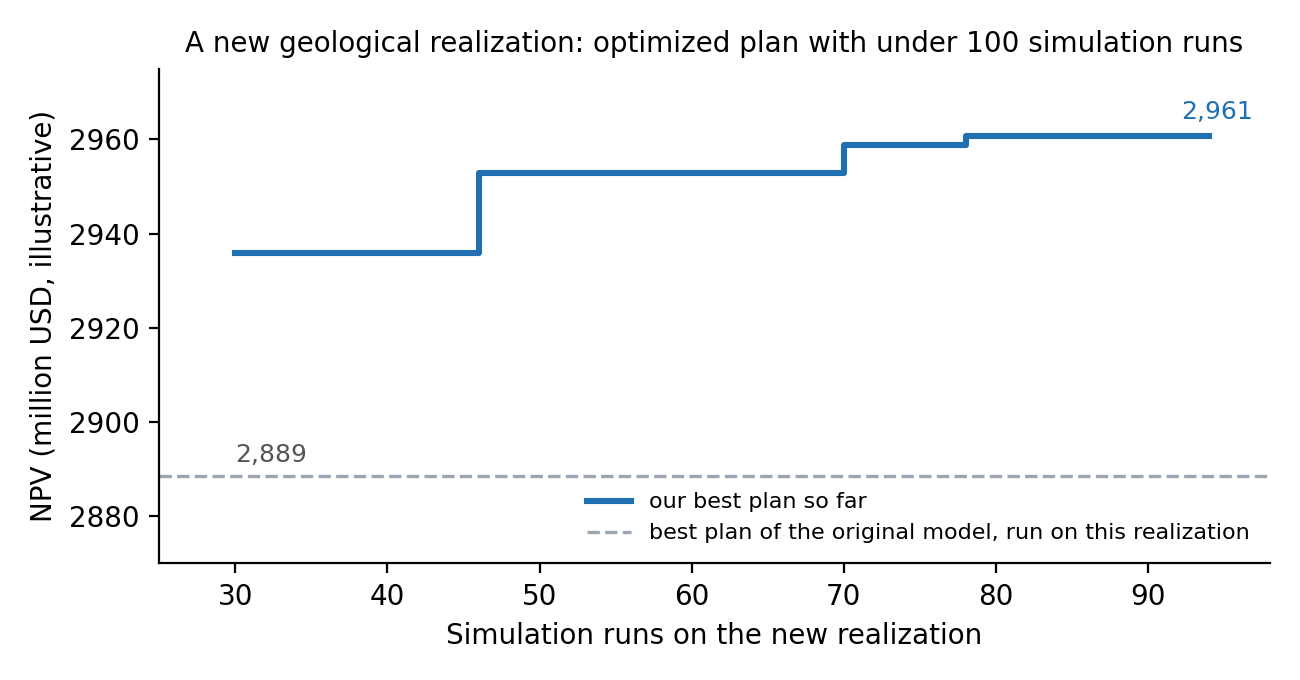
The result: 9.1% more NPV in the base geology
Norne is a real oil field in the Norwegian Sea, run by Equinor. For 2007–2017, in OPM Flow:
- $2.77 billion NPV
- Best plan from Everest+OPM
- $3.02 billion NPV
- Best plan from Everest+Surrogate, with the same oil and handling prices over the same 10 years
That is 9.1% more, worth $0.26 billion. This number comes from an OPM Flow run of our plan, not from the surrogate’s prediction, so the surrogate’s 0.5% error (see Hyper accuracy below) does not affect it.
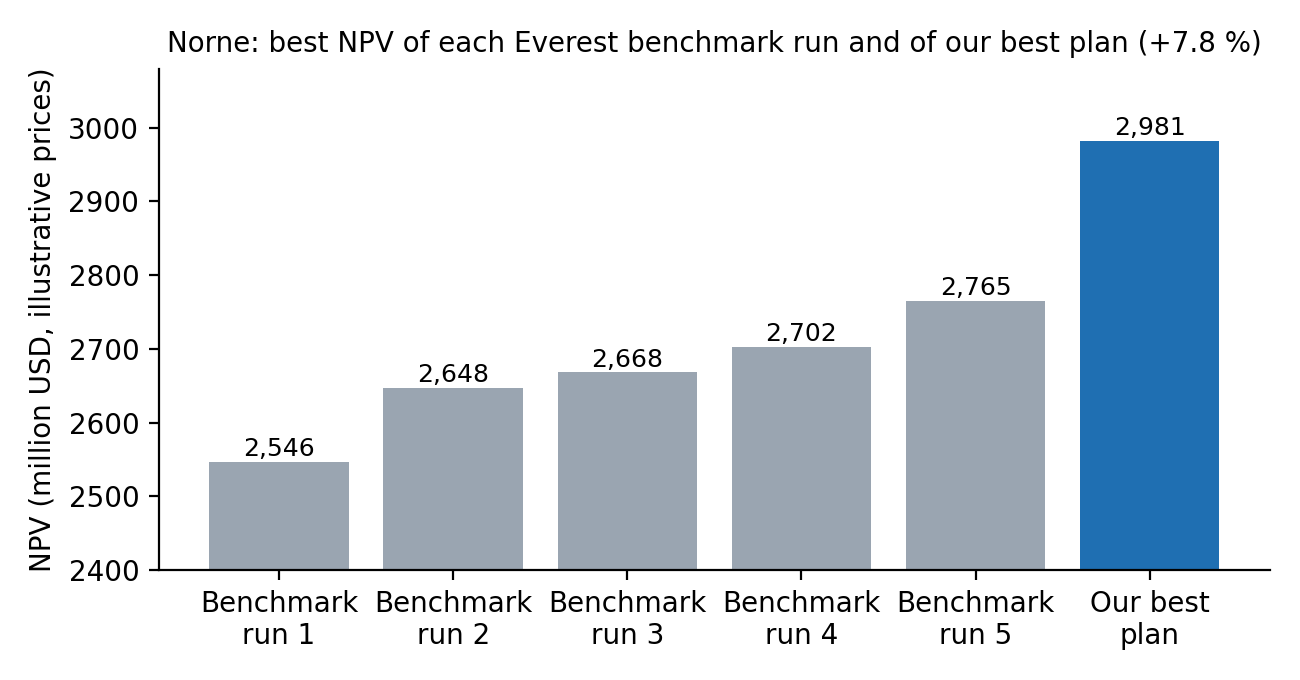
Same max NPV, better everything else
We searched the control space widely. We found 5 other control plans with the same max NPV (within 0.5%; three of them are even higher). These plans:
- produce 6–11% less gas and inject 5–10% less gas
- produce 2–5% less water and inject 2–6% less water
- use 4–9% less energy
- delay field water breakthrough from month 1 to month 28–32 (in four of the five plans)
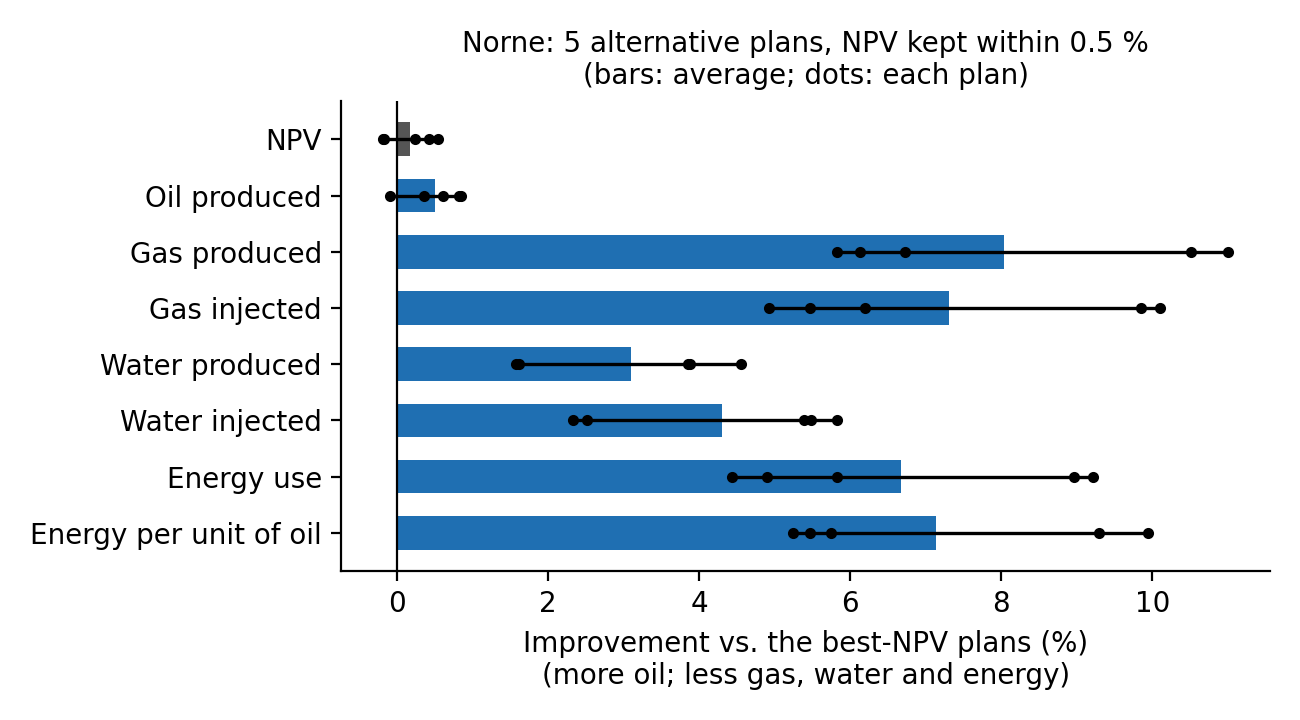
What else you get
-
Hyper accuracy
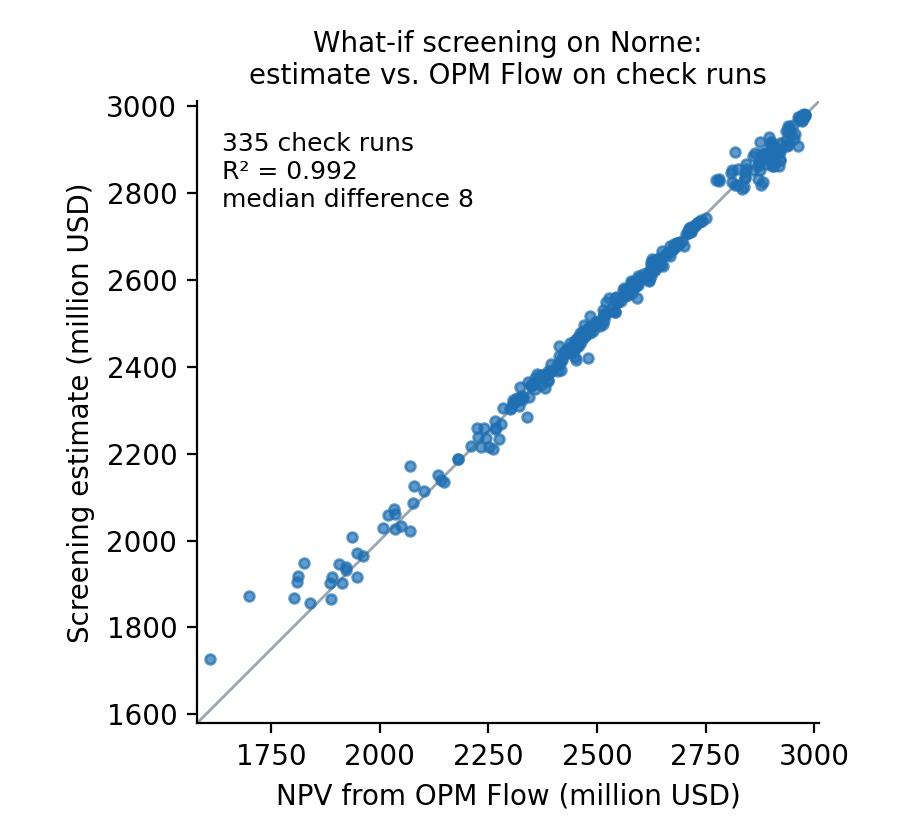
We tested the surrogate on plans it never saw in training. Its NPV is off by only 0.5% on average compared with OPM Flow (an RMSE of about $15 million out of about $3,000 million).
Still, we never report the surrogate’s numbers. We run every plan we deliver in OPM Flow, and OPM Flow sets the final numbers. Our surrogate is accurate enough that we are happy to have you rerun its plans the old way.
-
A benchmark you already trust
We always run a full Everest+OPM optimization on your field too, so you can see exactly how much more Everest+Surrogate finds. You get a reference your reservoir team can rerun and audit for every plan.
-
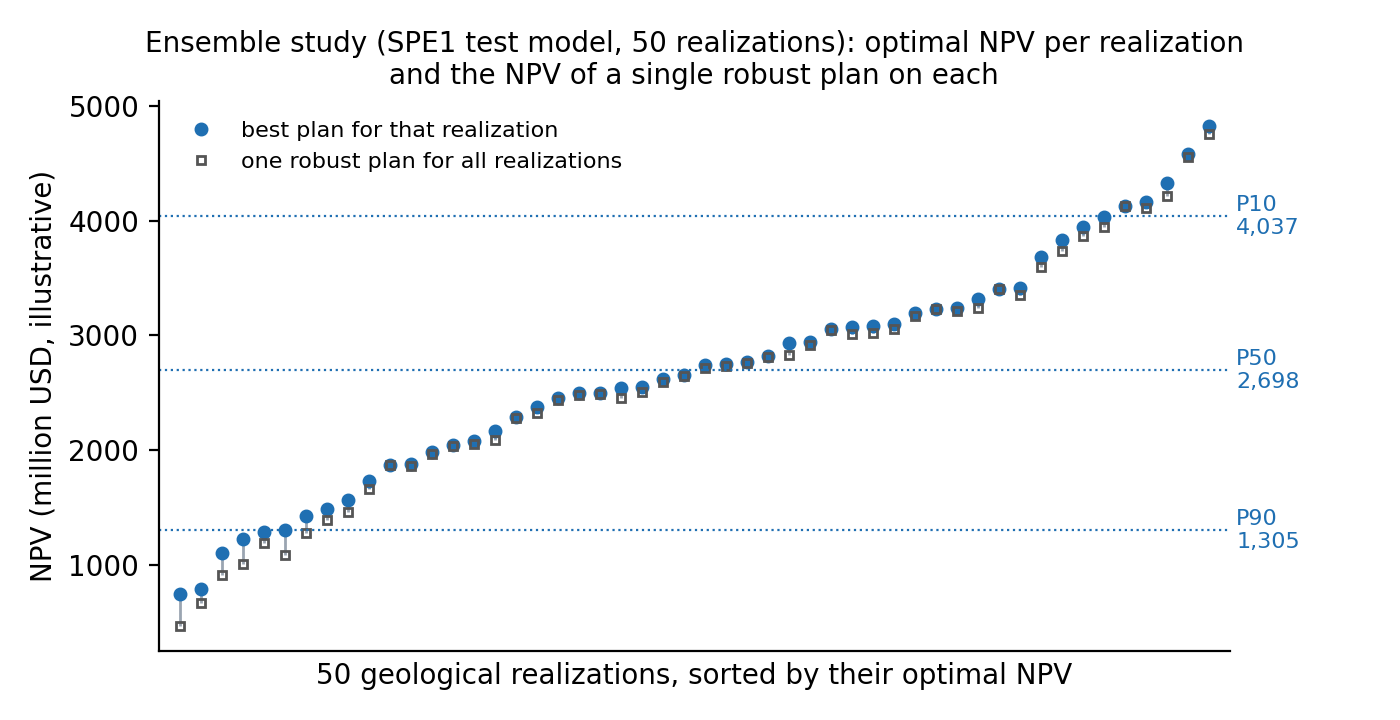
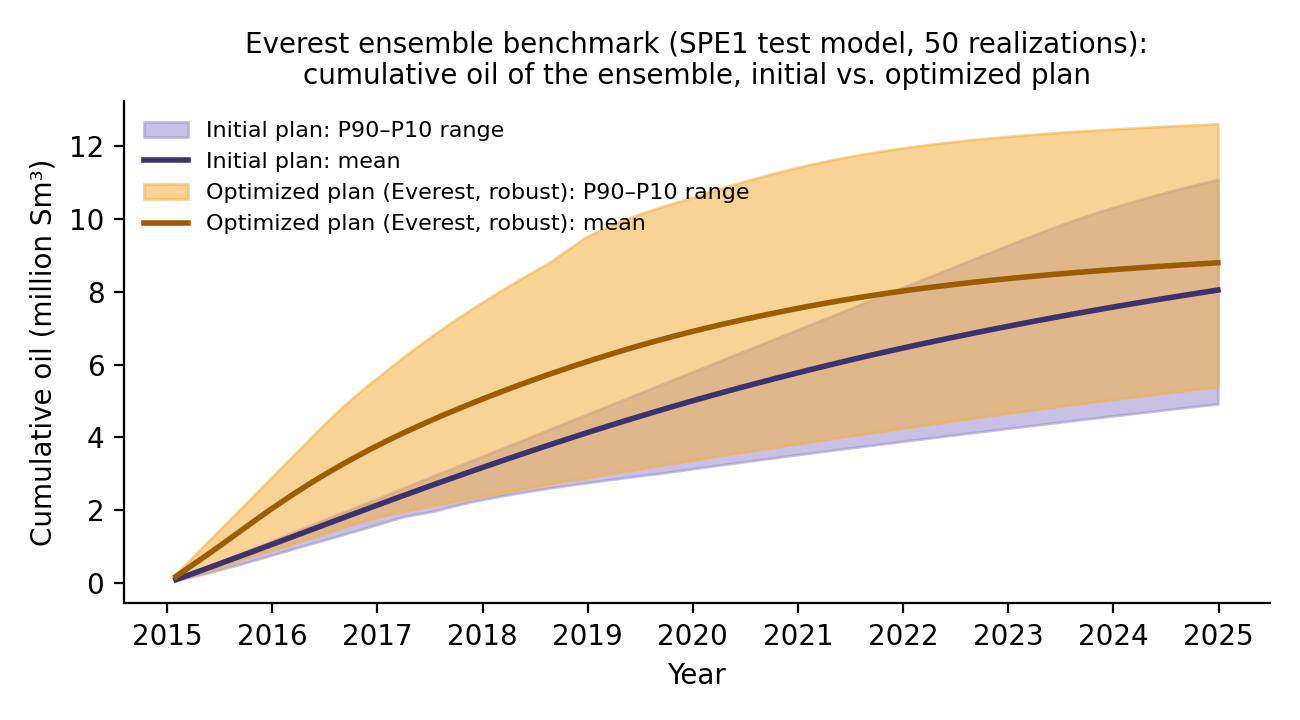
Every realization optimized, not just one
Our surrogate is very fast. You can optimize NPV and your other goals together, across all your realizations, and get a clearer P10/P50/P90 picture of uncertainty. At more than 100,000x the speed of conventional solvers, we find plans that work across the realizations you trust.
-
What-if screening
Put in any well control plan (rates and BHP). In the blink of an eye, 100,000x faster than conventional solvers, you get:
- NPV
- water injected
- water produced
- gas injected
- gas produced
- energy used
- water breakthrough
About
CompuFlair is founded by Ardavan Borzou, PhD, a physicist and data scientist building physics-based neural networks, and Razie Yousefi, PhD, also a physicist and data scientist.
To discuss your field
Send us an email or a LinkedIn message with a few time slots when you are available, and we will pick one and send a Google Meet link.